November 10th, 2021

Because babies’ teeth don’t appear until around six to eight months of age, it’s a natural misconception that they don’t need dental care. But the steps you take as the parent of an infant can help your baby maintain good oral health and develop healthy dental habits in the future.
It’s easy to take care of a baby’s teeth and gums, especially when oral hygiene for your infant becomes part of the normal daily routine. Learn more about how you can promote good dental health for your baby with these tips and considerations.
Taking Care of Baby’s Oral Hygiene
- Dental Hygiene for Birth to Six Months. Cleaning your infant’s gums is as important as cleaning teeth will be later. Hold your baby in your arms, and with a clean, moistened washcloth wrapped around your index finger, gently massage his or her gums.
- Dental Hygiene for Six to 12 Months. After teeth begin to appear, it’s time to switch to a soft, children’s toothbrush for teeth cleaning. New research has shown that fluoride toothpaste is safe and recommended for use once your baby’s first tooth arrives. Gently brush your baby’s teeth after each feeding, in the morning, and before bedtime, just as you did before teeth appeared.
- Good Bedtime Habits. One of the most important things you can do to protect your infant from tooth decay is to avoid the habit of putting baby to bed with a bottle. Use other soothing bedtime activities, such as rocking and lullabies, to help your baby drift off to sleep.
- A Note about Dental Decay. Many people are unaware that dental decay is transmissible. Avoid placing your baby’s bottle, sippy cup, or pacifier in your own mouth to test the temperature. Likewise, don’t share utensils with your baby.
Partner With Your Dentist
Your baby should receive his or her first dental health checkup by the age of six months. Even though your infant may not have teeth yet, Dr. Meuselbach can assess the risk your baby might face for oral diseases that affect hard or soft tissues. Dr. Meuselbach can also provide you with instructions for infant oral hygiene, and explain what steps to add as your baby grows and develops.
Robert Scott Meuselbach DDS is your partner for good oral health, and we’re here to make caring for your baby’s dental hygiene and health easier and more enjoyable for you.
October 27th, 2021

When it comes to keeping your smile looking its best, good oral hygiene is a must! Good oral health habits should start early and continue throughout your lifetime. Here, Dr. Meuselbach and our team at Robert Scott Meuselbach DDS suggest five habits worth adopting that will help keep your teeth healthy:
- Brush and floss regularly. Brush gently at least twice a day, paying special attention to the gum line to rid your mouth of food and bacteria that may lurk in between your teeth. Floss at least once a day. Replace your toothbrush every three to four months or sooner if the bristles are frayed.
- Make regular visits to see Dr. Meuselbach. Regular checkups (twice yearly) will help diagnose any dental problems early on when they can be more easily treated.
- Stop smoking. Did you know smokers are four times as likely as nonsmokers to develop periodontal (gum) disease? Tobacco, whether in the form of cigarettes, pipes, cigars, or chewable tobacco, increases oral and throat cancer risks, and raises the risk for candidiasis, an oral fungal infection. Smokeless tobacco contains sugar, which furthers your risk for cavities.
- Limit your alcohol intake. Heavy drinking dramatically increases the risk of developing mouth and throat cancers.
- Eat healthy. Avoid snacking on foods that contain high levels of sugar or starch. We encourage you to eat plenty of fruits and vegetables, which are known to help stimulate the flow of saliva to re-mineralize tooth surfaces and neutralize cavity-causing bacteria.
To learn more about the habits you should practice in between your visits to Robert Scott Meuselbach DDS, or to schedule an appointment, please give us a call today!
October 20th, 2021
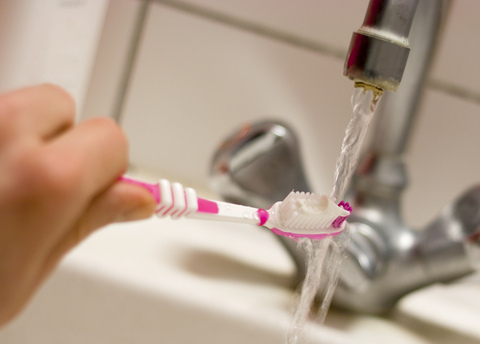
You may have heard talk about the germs that can reside on your toothbrush and thought, “really?”
It’s true—there are several kinds of bacteria that can lurk on the bristles of your toothbrush, including streptococci, staphylococci, Herpes Simplex I, and the Influenza virus. To protect your toothbrush from bacteria, Dr. Meuselbach and our team want you to consider the following three tips:
- Wash your hands before and after brushing.
- Allow the brush to air dry after each use, as harmful bacteria dies after being exposed to oxygen. It is best to disinfect your toothbrush weekly and allow it to dry in between use. Store the toothbrush in an upright position to allow water to drain and dry faster
- Replace your toothbrush every three to four months, or after being ill. Worn bristles are less effective in properly cleaning your teeth, and can actually be damaging to teeth if used too long!
We hope these tips help! Feel free to give us a call at our West Chester office or ask us on Facebook if you have any questions!
October 13th, 2021

Do you ever find yourself gnawing at your nails? Nail-biting is a very common and difficult to break habit which usually has its beginnings in childhood. It can leave your fingers and nail beds red and swollen. But if you think that your nails are the only ones getting roughed up by nail-biting you'd be mistaken—so are your teeth!
According to a study by the Academy of General Dentistry, those who bite their nails, clench their teeth, or chew on pencils are at much higher risk to develop bruxism (unintentional grinding of the teeth). Bruxism can lead to tooth sensitivity, tooth loss, receding gums, headaches, and general facial pain.
Those are some nasty sounding side effects from chewing on your nails. Most nail-biting is a sign of stress or anxiety and its something you should deal with. So what steps can you take if you have a nail-biting habit?
There are several things you can do to ease up on nail-biting:
- Trim your nails shorter and/or get regular manicures – Trimming your nails shorter is an effective remedy. In so doing, they'll be less tempting and more difficult to bite on. If you also get regular manicures, you’ll be less likely to ruin the investment you’ve made in your hands and fingernails!
- Find a different kind of stress reduction – Try meditation, deep breathing, practicing qigong or yoga, or doing something that will keep your hands occupied like squeezing a stress ball or playing with a yo-yo.
- Wear a bitter-tasting nail polish – When your nails taste awful, you won't bite them! Clear or colored, it doesn't matter. This is also a helpful technique for helping children get over the habit.
- Figure out what triggers your nail-biting – Sometimes it's triggered by stress or anxiety and other times it can be a physical stressor, like having hang nails. Knowing what situations cause you to bite your nails will help you to avoid them and break the habit.
- Wear gloves or bandages on your fingers – If you've tried the steps above and they aren't working, this technique can prove effective since your fingernails won't be accessible to bite.
If you're still having trouble with nail-biting after trying these self-help steps, it's best to consult your doctor, dermatologist, or Dr. Meuselbach. For some, it may also be the sign of a deeper psychological or emotional problem.
Whatever the cause, nail-biting is a habit you need to break for your physical and emotional well-being. If you have any questions about the effects it can have on your oral health, please don't hesitate to ask Dr. Meuselbach during your next visit to our West Chester office.